
ISO 9001:2015 Certified - Fabless Semiconductor ASIC Design Company - Montreal, Canada

CDI12100 – 12-Channel Sensor Analog Front End

CDI12100 - 12-CHANNEL SENSOR ANALOG FRONT END

Description

The CDI12100 is composed of 12 channels, each containing an amplifier, a rectifier and a filter.

The CDI12100 is available in a 48pin 6x6mm QFN.

Features

  • 12 amplifier, rectifier and filter channels
  • Carrier output signal (CLK/128) used to drive the excitation source
  • Built-in phase detector and rectifier
  • Accepts internal or external rectified signal
  • 14 programmable gains (27dB -> 93dB)
  • Good matching between filters (<1%)
  • Adjustable filter frequency and bandwidth using external clock (250kHz - 4MHz)
  • Operates at up to +/- 10V power supply
  • Low power (< 240mW overall power dissipation [20mW/channel])

Functional Block Diagram
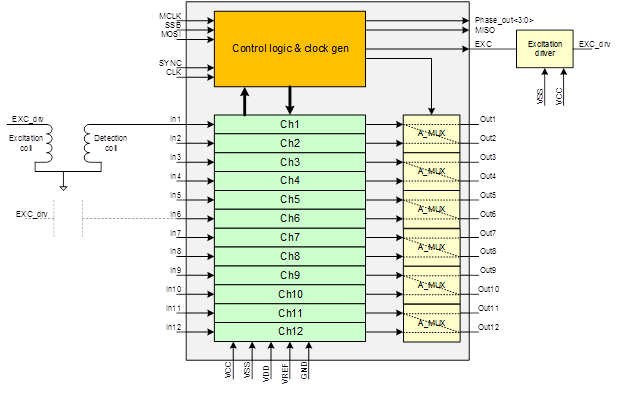
asic-diagram-2

Datasheet

CDI12100 datasheet (PDF)

Contact Us

For further information including pricing, configuration, and availability, please contact us.

Frequently Asked Questions

What is the CDI12100 ASIC? +

The CDI12100 is a 12-channel Sensor Analog Front-End (AFE) ASIC designed and manufactured by Comport Data. Each of its 12 independent channels integrates a programmable-gain amplifier, a rectifier, and a filter. The device is optimized for signal conditioning of sensor outputs, particularly in applications requiring amplitude detection of AC-excited sensors.

How many channels does the CDI12100 have? +

The CDI12100 has 12 independent channels. Each channel contains a complete signal-processing chain consisting of an amplifier, rectifier, and filter, all integrated within a single compact IC.

What package is the CDI12100 available in? +

The CDI12100 is available in a 48-pin, 6x6mm QFN (Quad Flat No-Lead) package. This compact surface-mount package is well-suited for space-constrained PCB designs.

What is the programmable gain range of the CDI12100? +

The CDI12100 offers 14 programmable gain settings, spanning a range from 27 dB to 93 dB. This wide gain range allows the device to accommodate a broad variety of sensor signal amplitudes without requiring external gain-setting components.

What is the power consumption of the CDI12100? +

The CDI12100 has a total power dissipation of less than 240 mW across all 12 channels, which equates to approximately 20 mW per channel. This makes it suitable for power-sensitive applications and designs where thermal management is a consideration.

What clock frequencies does the CDI12100 support for filter tuning? +

The CDI12100’s filter frequency and bandwidth are adjustable using an external clock, which can range from 250 kHz to 4 MHz. This allows the filter characteristics to be tuned in the field to match the specific sensor excitation frequency and desired signal bandwidth.

Does the CDI12100 support internal or external rectification? +

Yes. The CDI12100 is flexible in its rectification architecture, it can operate using its built-in phase detector and rectifier, or it can accept an externally provided rectified signal. This makes it compatible with a variety of sensor excitation and demodulation schemes.

What power supply voltage does the CDI12100 operate from? +

The CDI12100 operates from a power supply of up to ±10V, giving it compatibility with a range of system power rail configurations typical in industrial and sensor signal-processing applications.

How well do the CDI12100's filter channels match each other? +

The CDI12100 achieves very good channel-to-channel filter matching, with less than 1% variation between channels. This tight matching is important in multi-channel measurement systems where consistent frequency response across all channels is required for accurate relative measurements.

What is the carrier output signal feature of the CDI12100? +

The CDI12100 provides a carrier output signal derived from the input clock divided by 128 (CLK/128). This output is intended to be used to drive the excitation source for AC-excited sensors, ensuring that the sensor drive signal and the internal demodulation reference are inherently phase-synchronized.